Palm Tree Relocation & Mechanical Shifting Services in the UAE
Specialist relocation of mature Date, Washingtonia, Wax, and Coconut palm specimens between properties or across on-site developments. We manage precision root-ball excavation, certified crane rigging, permitted highway transport, and post-planting irrigation aftercare throughout all Emirates.
Arboricultural Feasibility: Monocotyledon Root Zones vs. Taproot Trees
Palm relocation involves fundamentally distinct mechanics from ordinary tree transplanting. Because palms are monocotyledons, their vascular bundles are dispersed across the entire stem diameter rather than concentrated in an outer cambial layer. Any trunk indentation or crush injury caused by substandard rigging slings will permanently compromise vascular transport, as the stipe cannot generate healing callus wood. Successful transplanting in the UAE depends on retaining an intact root-ball core around the root initiation zone (typically 80 cm to 150 cm radius), maintaining structural balance using wide padded rigging harnesses, and mitigating transpiration through frond reduction before transport.
The Complete 8-Stage Relocation Sequence
Every palm relocation project follows a sequential operational protocol designed to protect the tree crown, stipe, and active root initiation zone.
Site Assessment & Sizing
Evaluation of trunk caliper, stipe height, underground utilities, and crane outreach radius at both pick and drop locations.
Canopy Binding & Pruning
Outer fronds are selectively reduced by 30% to 50% to minimize water loss. The remaining canopy is bound with breathable strapping.
Radial Trenching
Trenching around the root zone at a calibrated radius (75 cm to 160 cm) to undercut the stipe without tearing core roots.
Root-Ball Encapsulation
The root ball is tightly wrapped in breathable burlap and secured with wire mesh or geotextile to prevent soil collapse during lifting.
Crane Rigging & Extraction
Certified 25T–50T mobile cranes use wide nylon slings with heavy rubber trunk armor to lift the palm vertically out of the extraction pit.
Permitted Highway Transit
Palms are secured horizontally on cushioned low-bed trailers. Wide-load approvals and root moisture barriers are maintained.
Destination Installation
Lowering into pre-conditioned, pre-hydrated pits. The specimen is oriented to matching solar exposure and set true with timber shores.
Irrigation & Aftercare
Establishment of a raised earthen watering berm and implementation of a 60-day deep root hydration program with anti-transpirants.
Specialized Crane Extraction & Trunk Cushioning
Lifting mature palms weighing between 2 and 6+ tonnes requires precise load calculation. Direct steel wire contact or unpadded slings will crush the vascular bundles beneath the palm’s outer fiber, causing irreversible dieback or crown collapse.
- Wide Synthetic Slings: Minimum 150 mm to 200 mm flat webbing to distribute weight evenly.
- Industrial Neoprene Trunk Armor: Heavy padding wrapped around the balance point to eliminate bark abrasion.
- Crane Radius Verification: Outreach calculations ensure mobile cranes operate well within safe lifting tolerances.
- Tag Line Control: Dual ground tag lines prevent rotational swinging near boundary walls or overhead lines.
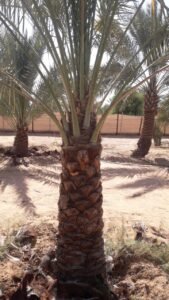
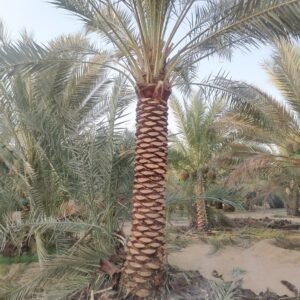
Palm Tree Shifting: On-Site Repositioning
When remodeling a residential garden, expanding a villa footprint, or modifying a commercial layout, existing palms often need to be moved just 10 to 50 meters rather than transported across highways.
On-Site Shifting follows the exact same root excavation and trunk protection standards as long-distance relocation, but eliminates highway freight costs and transport permits. Tracked mini-cranes, telehandlers, or all-terrain excavators walk the specimen directly to its new location on the same property.
- Eliminates highway transport permits and escort requirements.
- Enables immediate same-day replanting with minimal root desiccation.
- Allows precise realignment with new landscape architectural plans.
Seasonal Impact on Relocation Viability in the UAE
Temperature and humidity bands dictate transpiration rates and root recovery timelines across the Emirates.
| Seasonal Window | Temperature Band | Root Desiccation Risk | Recommended Operational Protocol |
|---|---|---|---|
| Optimal (Nov – Mar) | 18°C – 28°C | Low to Moderate | Ideal window for full specimen shifting; standard daylight handling; baseline root hydration. |
| Shoulder (Apr & Oct) | 29°C – 37°C | Moderate to Rapid | Morning-only lifting; 40% frond canopy thinning; immediate root-ball trench saturation. |
| Summer (May – Sep) | 38°C – 48°C+ | Severe / Critical | Twilight or night crane operations; anti-transpirant foliar misting; geotextile moisture barriers. |
Practical Factors Governing Relocation Costs
Fixed pricing for palm relocation is technically indefensible because access, tree weight, and crane radii vary drastically between sites.
| Cost Factor | Standard Parameters | Complex Site Challenge | Underlying Logistical Impact |
|---|---|---|---|
| Lifting Crane Capacity | Direct street access; 25-tonne mobile crane | Pick over 2-story villa; 50T–100T crane with long boom | Higher equipment mobilization cost and RTA street closure permits |
| Haulage Transit Distance | On-site shifting within same boundary | Inter-Emirate transit (e.g., Dubai to Abu Dhabi or Al Ain) | Requires low-bed transport trailers, route clearance, and escort vehicles |
| Subterranean Ground Stratum | Sandy soil or amended backfill | Solid calcified caprock layer requiring pneumatic breakers | Extended excavator hours and soil replacement volume |
| Tree Mass & Stipe Height | 4 m – 6 m single stipe specimen (approx. 2 tonnes) | 12 m – 18 m mature Washingtonia or heavy Date Palm (5+ tonnes) | Heavier rigging slings, multiple crane tag lines, and larger transport bed |
Frequently Asked Questions
Clear, evidence-based answers regarding mature palm moving feasibility, transit rules, and survival factors.
Need to Relocate or Shift a Mature Palm Tree?
Book a technical site assessment to measure crane access radius, verify root ball dimensions, and receive a customized operational plan.